Compounding operational intelligence

Every incident should
make you smarter.

Today it doesn't. Each one is solved once, by one engineer, in one head, and then the knowledge walks out the door. ByteLens turns your telecom operational data into a compounding knowledge asset. It lives inside your network and gets smarter every time you use it.
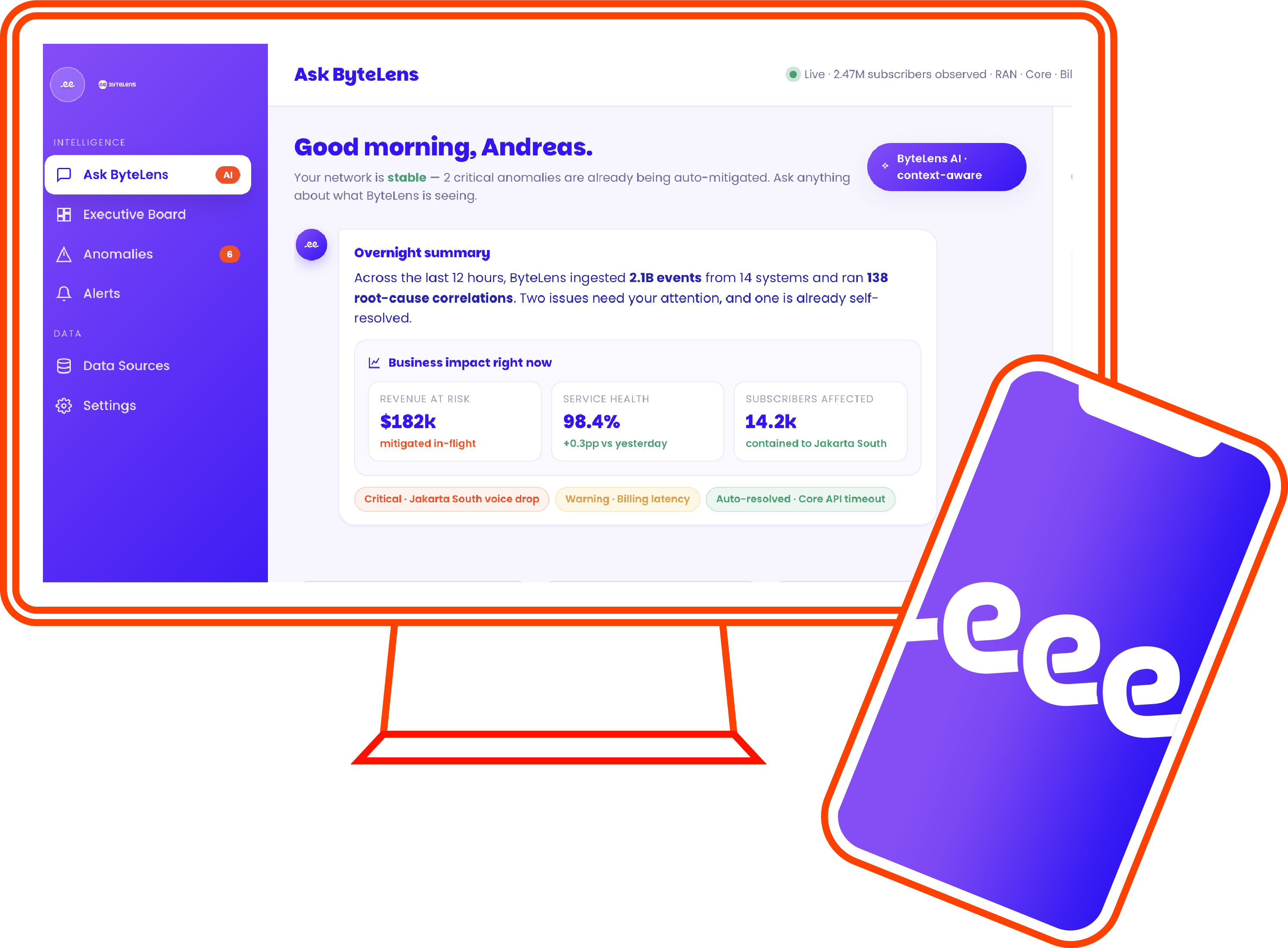
ByteLens shown on a desktop monitor and phone

The problem we own

The data-to-insight gap

Operators are not short of data. They are short of insight that lasts. Getting the data in was never the hard part; what happens after it arrives is.

Disconnected signals

Every vendor, domain and layer reports its own version of the truth. Nothing joins them, so nobody sees the whole event.

Knowledge locked in people

An incident is solved once, by one engineer, in one head. When they move on, the reasoning goes with them.

Perpetually reactive

The same failure returns and the next person starts from zero. Effort repeats instead of accumulating.

The gap is not integration. It is what happens after the data arrives.

What ByteLens does

Three lenses. One compounding asset.

One product, three ways into the same live operational knowledge. Find the cause, ask anything, see the customer. Each use makes the next answer sharper.

Root-cause

The patent-pending core. It correlates the telemetry you already produce across every vendor and domain, tells cause from coincidence, and returns the ranked root cause with the evidence behind it. Root cause in seconds, not war rooms. Every failure mode it closes is one your network never has to learn again.

ByteLens Explore

The executive lens. Ask a business question in plain language, by text or voice, and get an answer built from network, IT, customer, service and financial signals at once. Every insight carries its sources, its data freshness, its confidence and the reasoning behind it, so leaders can act on it rather than commission a study.

Customer Experience Observability

The customer lens. Churn signals, customer behaviour and mobility, sales patterns and the trouble subscribers actually feel, tied back to what the network is doing underneath. Technical events become revenue risk, churn exposure and SLA exposure you can put a number on.

Why it holds up

Gains compound. Complexity doesn't.

Cut MTTR. Cut repeat incidents.

Every failure mode you close removes its root cause for good. The curve bends down over time instead of resetting with each new quarter and each new hire.

Proven in live operator networks

Running in some of the world's highest-population markets. Not a lab demo and not a slide. Operational, inside the operator's own tenant, today.

Everything stays inside your perimeter

Your data stays yours. The knowledge ByteLens builds on it stays yours too, including the day you decide to part ways with us.

How it works

From a wall of signals to one clear answer

Four steps, run inside your environment, on the stack you already have. Nothing is replaced.

Connect

ByteLens reads the telemetry you already produce, where it lives, through OpenTelemetry. No new agents, nothing to re-architect, no second copy of your data.

Correlate

Specialist agents, one per source, analyse each store in place. ByteLens fuses the findings into a single picture of what depends on what, and tells cause from coincidence across the vendor lines that usually need a war room.

Explain

The answer comes first, in plain language, with sources, freshness, confidence and the raw signals one click away. The same answer serves the field engineer on a phone and the CTO at a desk.

Compound

Approve the fix, or let ByteLens run it within the limits you set. Every resolution and every override is retained, so the answer your team gets next time starts from what you already know.

Where we stand

Dashboards watch. ByteLens learns.

Plenty of good products will show you what happened. Very few make your operation permanently better at knowing why.

One product, every seat

It answers the question you actually have

ByteLens Explore is built around the decisions leaders need to make, not the systems the data happens to sit in. Same live data, same evidence, framed for the seat you occupy.

CEO

"Where are we seeing customer experience risk today, and what is the commercial exposure?"

Market performance, brand risk, customer impact and capital efficiency, in terms you can take straight to the board.

CFO

"Which network investments are underperforming against utilisation and margin expectations?"

Capex efficiency, opex control, asset utilisation and margin impact, traced back to the assets creating them.

CMO

"Which regions or segments are at risk from service experience degradation?"

Churn risk, NPS, complaints and segment performance, so you know who to reach, retain and win back.

CTO

"Which degradation patterns are emerging before they become major incidents?"

Cross-vendor root cause, the evidence that swung it, and the fix, ready to approve or let ByteLens run within policy.

Network operations

"Of everything alarming right now, what actually matters and what is downstream noise?"

One ranked picture instead of a wall of alarms, with the customer impact attached, so the NOC works the incident rather than the console.

Network engineering

"What exactly changed, where, and what is the evidence it caused this?"

Packet-level truth across vendor lines, the correlated signals that swung the call, and the same answer on a phone in the field as on a desk.

Same live data and same evidence underneath every one of them. Nobody has to accept another team's summary.

In good company

Best wishes from the industry

Voices from across telecom on the problem we're taking on.

The next wave of enterprise transformation will be driven by organizations that can harness AI while maintaining trust, security, and exceptional customer experiences. ByteLens is addressing an important challenge at the center of this opportunity, and I wish the team continued success as they scale and grow.
Ruza Sabanovic Ruza Sabanovic Executive Director, CP Group
Operating modern telecom networks is complex and takes up a significant part of an operator's attention. These networks are rich in data but lack actionable insights. AI holds real promise here, but it can't be bolted on after the fact; it has to be embedded into how the network runs. It's encouraging to see ByteLens working to close that gap by building intelligence directly into network operations. We wish the team great success as they bring this vision to market.
Jai Prakash Jai Prakash Recognised CTO in the world's largest telecom markets

The line we hold ourselves to

Prove it on your network. Not in a slide.

Pick the use case that is quietly costing you the most hours. We run a short proof inside your environment, on the data you already have, and aim for a measurable result in the first sprint. You keep the evidence, and the knowledge, either way.

Start a conversation